The Fallout Fallout

Fallout 76 is out and the verdict seems to be a public lynching

The first time I learned of Fallout 76’s existence was a week before its release when I started seeing reviews of its beta. To say I wasn’t really interested would be an understatement. I haven’t touched the series since Fallout: New Vegas which I bought at a bargain price, played a few hours then uninstalled.

I have found the Fallout series, in particular under the Bethesda banner, to be a messy, buggy, visually outdated, clunky games whose stories lacked agency and interest. The real interesting stories were often buried under terrible UI design and scattered in empty brown sandboxes. The shooting mechanics were terrible for a first person shooter and the character mechanics were too dumb for any serious role playing game. The worst of two worlds is the way I often viewed the series.

As disclaimers go, its quite long but I hope you readers get the message: I don’t like the Fallout game series. However, I can’t deny their cultural importance or the place they hold in mainstream gaming. Thus I just turn a blind eye to them and focus on more interesting aspects of gaming. For that reason, I had no interest in Fallout 4, only taking notice of its mixed reception the same way a passenger on a train takes interest in the landscape flowing past their window. Yet Fallout 76 seems to have done something quite extraordinary for me to not be able to ignore it: It made Fallout fans angry.

While I admit there is some satisfaction in seeing an enraged fanbase of what I view as mediocre game series turn on its creators, I have to try and think on WHY it happened. Why did this game offend so many in the Fallout community as to review bomb the game, have news outlets damn it and give it scores so low, lower in fact than Kane and Lynch, a game so terrible that it only warranted a 6(!) on Gamestop. Like a witness to a trainwreck, I feel compelled to watch and try to decipher the mess.

Watching the many reviews online, I personally don’t get the hate. Visually the game is indistinguishable from Fallout 4: Ugly. Bethesda games were always quite graphically impaired, filled with clunky character animations, horrible shooting mechanics and copy pasted interiors. Not much has changed on that front in Fallout 76. Next is the story or lack of. People complain about the fact there are no NPC characters to give life to the wasteland but in all my experiences with Fallout 3 and Fallout: New Vegas that is an upgrade. Bethesda’s Fallout series never had much life in it and what NPCs you could interact with would often stare at you lifelessly or repeat their pre-programed routine, making you feel as though you were wandering in an animatronic theme park.

Next comes the bugs, but as infuriating and game crashing as Fallout 76’s bugs are, how do they differ from all the previous incarnations in the series? Bethesda has a reputation, A REPUTATION, as a shoddy game developer that pushes half baked products on store shelves, does only the minimal bug fixing and often relying on the community to debug its games. Those that bought the newest game have no right to be outraged in that regard.

Gameplay then, is the last aspect to explore as to the cause of the outrage. That said, there is little change on that front. It is still the same horrible shooting mechanics and lack of meaningful character progression. This time though, instead of choosing perks every few levels you get ability cards that help customize your character and perhaps supply an opening for another avenue of microtransactions. Not much change from Fallout 4. There is still the stupid looting and building mechanics that add very little to the game. The only two major changes in my eyes are the survival aspects (needing to manage your food and water) and the VATS system.

The survival aspects themselves are almost token, and don’t seem to intrude much on the overall Fallout experience while the VATS system change is, well, dumb. In the past, VATS was a nice pause button or a free “Get Out of Jail” card if things got hectic in a shootout. You could take time to pick targets, choose what organs to shoot for maximum success\damage then see it unfold in slow motion. Since Fallout 76 is an online multiplayer game, you can’t really pause the server for every individual so VATS was changed to basically an aimbot. No, I am not kidding. It is literally an aimbot, allowing you to target an enemy and lock onto them with your weapons with hardly any player input.

Did I forget to say Fallout 76 is an online multiplayer game? Yeah, I guess we found the reason for the outrage. The biggest problem for Fallout 76 is its multiplayer aspect. Not because the experience itself is horrible, after all as I demonstrated, there is little deviation from the games that came before it. That said, by making it a multiplayer game, Bethesda has pretty much shot itself in the foot.

The problem with making it a multiplayer game is that what little immersion there was in the game is basically ruined. Not only are the people in the server total strangers who may dress in wacky outfits and make rude gestures at the player, they also queue to the same events and stories, meaning they hinder quest completion as well as the immersion itself. After all, part of the “Charm” (With the biggest quotation marks possible) was the solo exploration aspect.

Don’t get me wrong, players had been clamoring for a cooperative Fallout experience (The sadists!) but not one populated by a myriad of strangers who keep running around, knocking things over and just reinforcing the emptiness of the world. In a way, Bethesda managed to expose the cheapness of the Fallout experience by shedding light on it with multiplayer gameplay.

Of course, this isn’t the only reason why Fallout 76 is receiving such pillorying. The multiplayer only aspect was merely the catalyst that lit the powder keg. The real explosive powder was the fanbase’s expectations of the game. While Bethesda marketed the game with an emphasis on multiplayer and survival, they did try to have it both ways by either being evasive on the singleplayer aspect, (You know, the thing that made the series popular) or claiming the multiplayer aspect won’t hinder it (Which it doesn’t, until you get disconnected from the server and lose all your progress). Of course, they also lied about performance and graphics but that is small potatoes compared to the main selling point of the game – Exploration.

After all, Fallout games (and Elder Scrolls games for that matter) are all about the exploration. You can yell “Story” from the top of mount Everest for all you like, but all Bethesda main stories (and many side stories) are total rubbish. Playing more than two hundred hours of Skyrim I didn’t feel once the urge to continue the main plotline. It was the lore and exploration which drove the game for me. The same is true for Fallout. The game series is good in spite of its stories, not because of them. However Fallout 76 doesn’t even have that good an exploration drive. After all its not the player exploring an unknown wasteland, its a bunch of players doing it. With the spell of crafting a unique experience broken, all the faults that have existed in the series since Fallout 3 came to bite its studio in the ass.

Yes, there is nothing new in the complaints of the Fallout fanbase. Bethesda continued to dilute the series, dumbing it down for mass appeal. It seems that this time they simply crossed a line that allowed the rubes to realize they were robbed. The degradation of the series was there for all to see, but I guess you only become aware of it with a crowd, with open mics running around an event and killing the boss before you can get your chance.

I feel like a lot of the outrage comes from waking up. The army of fans who really liked the series and deluded themselves into thinking a messy, buggy game that somehow gets worse with each iteration is worth it for the experience. When that experience was cheapened by the addition of the online component, they woke up to see they’ve been living in a slum catching fire and the landlord doesn’t give a damn saying instead “It just works!”. Yeah, I guess I’d be angry too.

That said, the only recourse those fans have is either try to force a refund (Which is a tad problematic since Bethesda made their own launcher and sold it outside of Steam for what I believe could be this very reason) or boycott Bethesda products. Don’t buy the new Starfield and Elder Scrolls VI. That said, we all know that fans often like to forgive abusive game companies because they liked previous games of theirs and they hold franchises to ransom. I don’t like to make allusions to battered spouses, but it sure feels that way. Would Fallout 76’s outrage live long enough to make gamers ditch Bethesda? I feel a tad cynical in saying “I don’t think so” because like every battered spouse they’d go back after a promise of “We are sorry” and “We will change and take your feedback into account”. After all, they made Skyrim! (and how many years has it been since Skyrim?). Todd wouldn’t lie (narrator’s voice: Todd always lies).

Bethesda, Bethesda never changes.

Warhammer: Vermintide 2 Shadows Over Bögenhafen

Shadows Over Bögenhafen is the new Downloadable Content (DLC) available for Warhammer: Vermintide 2 which came out more than a month ago. I stumbled across it when I saw a sale for the base game in my steam feed. Since I enjoyed the base game and the asking price (equivalent of $10) was reasonable I thought why not and bought it.

For a review of the base game you can go here, but suffice to say that the DLC doesn’t change the basic gameplay. It remains a co-op horde survival game with an emphasis on melee, an interesting loot and crafting system as well as plenty of character. I loved it the first time around and I still do. What the DLC itself adds are a couple of things that in hindsight should have been included before as well as a mini campaign.

The mini campaign takes place in the city of Bögenhafen where a powerful chaos artifact named the Blightreaper had been locked for safekeeping. When the Skaven and their Norscan allies, the Rotbloods, attack the city in order to take possession of the artifact, its up to the Ubersreik Five to stop them.

The mini campaign itself consists of two maps, each a sprawling district of the city. You start in the piers and go through the poor district before crossing over to the main city, traveling through the sewers and emerging into the upper levels. The map design itself feels a tad sloppy compared to the expertly crafted maps of the base game. I often found myself at dead ends forced to backtrack or going in circles. Another element that distinguishes these maps is visibility. In each map there is a part where due to circumstances (smoke or lack of light) visibility drops nearly to zero, making it harder to see incoming enemies or rely on ranged weapons. In particular the second map where in the first half you wade through pitch black sewers, forced to carry a torch which further diminishes your offensive and defensive capabilities.

20181003163715_1

Enemy wise, its still the same deal. You have squishy hordes, tough elite enemies and bosses which can easily demolish a party if spawned in a tight claustrophobic room, which happens from time to time. In regards to the boss spawns, it seems like it was tweaked as in many maps I found myself fighting two bosses, sometimes even three.

Graphics still look gorgeous and the new maps have great visuals. Magnificent sky boxes, excellent lighting, sweeping vistas all contrasted by the grim mire of the unplanned urban sprawl and unkempt sewers. Echoing my words from the previous review, the art team has really gave it its all and it shows.

That said, the mini campaign only adds about an hour of gameplay in total. Thankfully, Fatshark, the game’s developers, were smart enough not to divide the community and allow all players to play the new maps in Quick Play mode. I also found out that you can select the new maps and play them even if the rest of your party doesn’t own the DLC, which is neat. Props where due.

The second major addition is Okri’s Challenges. An addition to the game that tracks and rewards players. There are 207 challenges in total, some as easy as finishing the campaign, leveling a character or killing a boss. Others require completing an insane number of missions on hard difficulty or killing a certain enemy in a certain way. Each challenge unlocks a reward, either cosmetic or a high level chest which will probably contain powerful gear. By the way Electronic Arts, this is how you instill in your playerbase a sense of accomplishment and pride. The fact that the cosmetic items cannot be bought and must be earned is really a throwback to better times in gaming when character appearances denoted skill.

20181003163452_1.jpg

Like I said, this is something I feel should have been in the base game at launch. The fact however, that it was added with the DLC and even given access to the entire playerbase is commendable. It gives better purpose to grinding, as in the past it was just for better loot and completion’s sake (i.e. complete the game in every difficulty). It also helps retain players’ interest far better and incentivizes playing different characters and builds, something that was surely lacking before. This is evident in that fact that even though my main is Kerillian, I’ve been playing other characters in an attempt to level them up and complete challenges.

Another tool to help keep players’ engagement is the daily and weekly challenges. Daily challenges are available to all players while weekly ones are only available to DLC owners. The daily challenges often involve slaying 3 monsters as a party, or gathering 3 tomes or grimoires and so forth. They can be usually done under an hour with a full party or up to a couple of hours of solo play. They often reward the players with a valuable chest, thus helping weaker players gain good gear. The missions themselves reset at midnight GMT time. The weekly missions reward players with cosmetics chests (either weapon or character) and take significant more time. By myself it took around six to eight hours to complete the objectives. That said, since they reset only once a week, players have more time to finish them and once more, with a group they take significantly less time to clear.

This leads me to the final addition to the game, cosmetics. Though there were some alternate costumes before, the new DLC added a slew of them. A lot of them can be unlocked via challenges as stated before, each an indication of an accomplishments. Other varieties can be found in the Bögenhafen chests that are given by the weekly challenges. This includes hats, outfits and portrait frames. Also expanded upon were the weapon skins (also known as illusions) with new ones added. Whats more, now new weapons skins can be obtained via the same Bögenhafen chests. Thankfully, you can transfer weapon skins between weapons due to the game’s crafting system (thus you don’t feel like you wasted them, unlike another certain game *cough* Destiny 2 *cough*). Overall though, I found this aspect of the DLC the least interesting for me because the original look of the characters was already great (again, much credit goes to the art team) and I usually don’t bother much with character customization.

20181003173359_1

Overall, the new DLC injects new vigor in the game. Thanks to it I’ve gone back to playing Warhammer: Vermintide 2 regularly and so have some of my friends. The fact that I still grind day in and day out so long after completing the main stories is both a testament to the game’s strength and the DLC’s additions.

If you can afford to buy the DLC, I highly recommend it, and even if you can’t, I suggest going back to Warhammer: Vermintide 2 to check on the free updates. I guarantee you’ll get hooked back.

Stellaris: Distant Stars

Reviewing a Paradox Interactive game is a tricky job. Within a year or two the game receives patches, new expansions and downloadable content, changing it completely. For long time Paradox Interactive customers such as myself, the base game is viewed as merely a foundation upon which the company will often build upon. Examples of this abound with Crusader Kings II, Europa Universalis IV and Hearts of Iron IV. Stellaris is no exception and while the base game is solid and fun, thanks to expansions such as Utopia and Apocalypse, it has changed considerably. Now Distant Stars comes along to add another layer to the foundation.

Being a downloadable content pack, Distant Stars adds a lot to the game. Rather than breakdown every addition, I want to focus on what I view as the main selling points of the pack. Otherwise I’d just be parroting the change log. First and foremost, Distant Stars adds a whole slew of events to the game. Stellaris already had a large number of events which gave life to its randomly generated galaxy. Distant Stars adds even more, prolonging the exploration phase and giving players who focus on it further benefits. Some of the new events have quest chains and consequences which I’d rather not spoil in the review. Suffice to say they are all interesting and quite surprising at points.

Another noticeable change brought by the content pack is for anomalies. Before, anomalies would be ranked on a 1 to 5 scale and could be failed, leading to some catastrophic events (and dead scientists). With Distant Stars, anomalies rating scale was doubled, reaching to 10. Furthermore, scientists can no longer fail anomalies, turning the ranking into as a multiplayer which increases research time. The balance of risk versus reward is still maintained though as the multiplayer can really stack up. Occupying a single scientist in an exploration vessel for upwards of two years to research an anomaly is a waste of resources, especially in the early game where every exploration ship counts.

Other additions include two new Leviathans, each with their own unique rewards. New perks as well as changes to old ones (Master Builders receives a huge overhaul that makes it even more desirable). Re-balancing of traditions. A few new technologies including an ability for science ships to travel via sub space, thus circumventing bottle necks. The hyperlane generation has also received a fair bit of tweaking, creating more bottle necks and natural constellations which allow for a proper strategic depth. AI difficulty scaling returns, having been previously stripped from the game, for people who want more challenge. The marauders’ behavior was also improved and once a player empire reaches a certain level of naval power, they would call off raids. Pirates spawn was adjusted and now they won’t spawn every decade (by mid-game, if you manage your empire well, they wouldn’t spawn at all). Some event fixes were also added, in particular the Enigmatic Fortress and the Worm-In-Waiting.

stellaris_2018-06-11_22-20-01.png

Yet I haven’t talked about the most major addition to the game – The L gates. L gates are a new mid-game crisis centered around these gates. Unlike other gateways, these spawn only in black hole systems at their center and are scattered all over the galaxy. They each bear the name “L Gate” and cannot be restored even if the player had researched the gateway activation technology. Instead, the player needs to gather seven insights through exploration. Once all insights are gathered, a new technology would become available called “L Gate Insights”. Researched, it will create a special project for a scientist to preform on the first L gate whose system the player had claimed. The L gates all connect to a constellation outside of the galaxy known as the L cluster.

Without spoiling what is out there, I can say that the gates were sealed for a reason. That said the L cluster has its own rewards. Special strategic resources that can only be found there, plenty of colonizeable planets that can be quickly and cheaply terraformed and lets not forget the L gate itself which connects to dozens of locations across the galaxy. This makes the L cluster quite valuable not just economically but also militarily. However the L gates must be treated as a proper mid game crisis, albeit one the player has some control over its timing (unless the AI beats you to it, at which point you are most assuredly in trouble). Thus opening the L gate should only be done when the player is truly prepared for it.

Graphics wise the content patch adds binary and even trinary star systems, brown dwarf suns and ice belts, making the universe even more beautiful and varied. Sound wise I haven’t noticed any additions to the soundtrack though it is solid as ever. That said there are a few new voice packs for notifications as well as a fully voiced tutorial advisor which can aid newer or returning players.

Overall I had a lot of fun with the new content and it did get me back into playing Stellaris for a few weeks straight. All the additions are solid and for its price tag of 10$ I feel like I got my money’s worth. It feels weird to grade a downloadable content pack but I’d give Distant Stars a solid 8/10 as it adds a lot to the base game. That said when it comes to recommending it, I’d put it strictly for Stellaris fans only. If you don’t like Stellaris or were turned away by the major changes in the Apocalypse expansion, this content pack won’t change your mind.

8/10 for Stellaris fans only.

Endless Space 2: The Most Disappointing Game I Played in Years

Endless Space 2 is the most disappointing game I’ve played in years. Not the most disappointing ever, that dubious honor was claimed by Rome II: Total War, or perhaps Command&Conquer: Red Alert 3? I am pretty sure SimCity is also a strong contender… Suffice to say there are a lot of games that had caused me no small amount of anguish, but Endless Space 2 is the most recent, and the one that sticks in my head the most.

For some context, the first Endless Space was a 4x (eXplore, eXpend, eXploit and eXterminate) released in the dreary year of 2012. At the time 4x games were few and far between, the genre having fallen out of favor with large publishers as the industry shifted more towards FPS and sandboxes to cater to larger demographics. 4x after all, has always been a niche genre, one which grew smaller in comparison as the explosion of gaming brought more players into the market.

That said, Amplitude Studios, the developers of Endless Space, saw an opportunity to cater to that neglected niche. Their debut title, appropriately titled Endless Space, brought them much acclaim and sold well. Well enough in fact that the studio was able to develop more titles set in the fictional universe of said game.

There is no need to be starry eyed about the first Endless Space game. It was quite a simplistic 4x game with rudimentary combat system, bare bones ship design and very basic empire management elements. It was also limited in scope, its generated universe felt quite small. That said it had many redeeming qualities. It managed to create a unique universe whose setting genuinely intrigued me and which made me want to play more to explore and find relics and clues about its past. Graphically, the game was stunning. Not only did the environment look great, but the artwork employed throughout the game for events was nothing less than stunning, something which would become the studio’s defining hallmark. Each of the factions had a distinct look and feel to them that made them stand out. Sound wise, the game had great music and ambient sound. Whatever deficiencies the game had in its core gameplay, it more than made up in its looks and sound.

For those wondering, the setting of Endless Space and the universe it spawned is the downfall of the Endless, a precursor civilization which colonized the galaxy first. It created many technological wonders including Dust, a resource in the game that is one part currency, one part nano machines (Hideo Kojima’s favorite word) and two parts magic. However, the Endless civilization came to an abrupt end of its own design, as a civil war between two factions tore its empire apart and brought doom to the entire race. The player assumes the reins of one of the subsequent races which reached space faring capability and must walk in the footsteps of the Endless.

That said, Endless Space may have been a hit in 2012, but since then much had changed in the gaming landscape. The explosion of Steam, Kickstarter and other platforms led to a second renaissance for genres that had long been forgotten by the large publishers. Smaller publishers, unable or unwilling to compete with the likes of Electronic Arts, Ubisoft and Activision Blizzard seized on the opportunity and brought to the fore some of these new games. With remasters growing popular, older properties saw a resumed interest and even a revival, with studios developing sequels (for better or worse). One of the main beneficiaries of these developments was the 4x genre.

The true game changer for the 4x genre would come at 2016, when Paradox Interactive would throw its hat in the ring. For those unfamiliar with the developer\publisher, Paradox Games is a company best known for its grand strategy titles. I myself must profess to be a big fan and customer of the company, having bought and played many of its games such as Europa Universalis IV, Hearts of Iron IV, Crusader Kings II and Victoria II. However, the company’s forte has always been in creating historically accurate games which translate the period they depict through complex mechanics, often iterated upon with DLC and expansion over the course of years. No one knew what to expect of their foray into true 4x territory.

The result would be Stellaris, a game so addictive as to be worrisome. It had a greater scope, more events and allowed for greater faction customization. That said it also had a very basic combat system though it did allow for static defenses and its ship design element was also lacking. Yet, when it came to empire management and colonization, it had a much more robust system than Endless Space. The other advantage the game held over its competition was Paradox Interactive’s continued support. Like many of their other in-house products, Paradox Games continued developing and releasing content for the game, slowly populating it with menacing leviathans, mega structures such as Dyson spheres and even re-working its entire faster than light system to deepen its strategic element while also further fleshing combat.

Thus, as time went by, Stellaris got even better. Any game hoping to compete with it had to overcome a huge hurdle. Sadly, Endless Space 2 was not up to the challenge. To be frank, I didn’t even hear about Endless Space 2 until a cursory glance in the Steam store as I waited for the newest expansion for Stellaris to hit shelves. That is not a good sign, considering I am pretty much the target demographic. In the end I did get a copy of the game from a friend and loaded it up, and the result was mixed feelings and a sense of missed opportunity.

By all accounts, Endless Space 2 was just more Endless Space. A lot had been refined and polished, with a few tweaks and additions but remaining overall unchanged from the original. Combat remained shallow, ship design received only an incremental improvement and the scope was virtually unchanged. System and empire managements did not progress at all and were kept as token only. On the other hand, the story elements had been further developed, with factions receiving unique quest lines to follow. The artwork was stunning and overall graphics had been brought up a notch. The soundtrack itself was so good that I actually bought it, something I have never done before.

But I wasn’t having fun. The more I played of the game, the more a certain clip started playing in my head. Any Red Letter Media fan who watched their review of the Pixels movie would be familiar with it. In it, Adam Sandler repeats the line “I haven’t progressed”. That was the feeling I got from the game. Scrape off the fancy facade and all I was left was an Endless Space n+1. Perhaps that was good enough for the casual player or die hard fan, but for me, it felt almost insulting. I expected more from a sequel but felt I’ve gotten instead an expansion pack. Had I bought this full price, I’d have demanded a refund.

The revelation itself shocked me. No matter how many times I tried to get into the game, after a couple of hours I’d quickly give up and play some other game. When Stellaris:Apocalypse rolled into stores I had already abandoned the game, uninstalling it.

When I first sat down to write the article I had a clear goal of just savaging Endless Space 2 and comparing it to Stellaris which I hold as a better game in almost every aspect. However as I delved into the writing, a strange realization came over me. Objectively, Endless Space was never a great game. As described in the opening paragraphs, it was a very basic 4x game released in a time that such games were a rarity, especially as polished as it was. Perhaps I let those memories taint my view and create unreasonable expectations for its sequel, which as I pointed before, came out at in a very different climate. Perhaps what I saw as a good game was merely adequate. Perhaps what I view as mediocre is quite in line with the overall series.

Following this line of thought, I decided to try and rate both the first and second Endless Space games. The result was a 6/10 and 7/10 respectably. Not terrible scores, but not great either. Both games fall into the spectrum of good, just above mediocre.

Thus its not hard to see why Endless Space 2 disappointed me so much when taking all of this into account. I expected something from the series that it never had an intention of supplying. I wanted another Stellaris set in the Endless Space universe, something Amplitude Studios couldn’t, and never intended to, make. I forced my own wishes on the game and when they were left unfulfilled I came to blame the game rather than myself.

Endless Space 2 is the most disappointing game I’ve played in years not because it was bad, but because of my own expectations. I thought Amplitude Studios would build on the success of the first game and make a sequel that would expand on every metric. Instead, they chose a safer route that was more in line with what their fans expected. It was my mistake to believe they’d take a riskier route. Perhaps they know their customers better, perhaps they are just following the trend in gaming of safe, familiar design. Perhaps, Endless Space was never really meant to be anything more than “My First 4X Game”.

Perhaps.


Battletech

I am no stranger to the Battletech universe. As a kid I played several of the MechWarrior games so I have a passing familiarity with it. That said, the newest game set in the universe, Battletech (Yes, that is not going to be confusing in the future whatsoever) which had just recently released allowed me to get a deeper dive into a universe fraught with war and giant robots, known as Mechs.

For those unfamiliar with the setting, the game does a good enough job summarizing key points. Suffice to say its the 31st century and everything sucks. Humanity has spread across hundreds of stars but has lost a lot of its technological advances thanks to internecine wars which wreaked havoc on many worlds. Thus, people cling to what working relics of the past they can maintain as a new feudal society rose to prominence, with the Mechs – giant bipedal war machines, acting as its equivalent of knights, only dozens of meter tall and able to destroy a small city with Gauss rifles and phased plasma cannons. In this universe, noble houses wage war with each other over planets and technological relics.

The story itself is set in the Aurigan Reach, a region of space in the Periphery, located between several of the major powers in the Battletech universe. The player takes the role of a mercenary captain, down on their luck with debt and loans piling up. When a mysterious client offers the player a chance to climb out from their financial black hole, they’ll get embroiled in the struggles of the noble houses in the Reach.

The main story of the game wouldn’t shame a season of Game of Thrones. There is a healthy dose of drama, intrigue, backstabbing and reversals to truly engage the player. The various supporting characters all play roles in the bigger story and have interesting backgrounds of their own. The motivations of all parties are quite fleshed out, amplifying the tragedy of their actions. Suffice to say the story both surprised me at points and had me invested in it heavily. That said the game takes place before the invasion of the clans, so sadly no Timber Wolves.

Gameplay wise, the game is of the tactical turned based combat genre. The player operates a squad of 4 Mechs (also known as a Lance in-universe) which they can customize beforehand. Once deployed, the Mechs will be under the player’s control as they attempt to complete objectives. The combat system itself can be described as complicated at best, and obtuse at worst.

Mechs are assigned their combat turn per round depending on their initiative, which is dictated by their class and pilot skills. The heavier the Mech, the later its turn in combat would come. If the player has several Mechs with the same initiative, they can choose whichever one they wants to move or decide to reserve them, thus further delaying their turn. Mechs are usually able to move first then shoot. The further a Mech travels the more evasion it gains, making it harder to hit by the enemy.

Thus movement and positioning are key in combat. Mechs are armored, with the front and sides being the most heavily armored parts. Its important at all times to present the front of the Mech to the enemy as it is able to absorb the most damage while maneuvering to the back of hostile Mechs and vehicles where the armor is thinnest. A Mech that doesn’t move during its turn will simply become a sitting target.

Terrain itself is vitally important. Battletech operates both on elevation and lines of sight. Certain weapons require unobstructed line of sight while others offer indirect fire, not to mention the ranges. The game does a good job showing firing arcs, optimal ranges and whether the target is visible or hidden behind terrain. The other role terrain plays is in stability and heat management. Mechs, being bipedal walkers, must be stable. Weapon impacts may destabilize them, causing them to be knocked down which injures the pilot, temporarily decreases initiative and allows the enemy to get Called Shots (focuses the firepower on a specific part of the Mech, thus able to inflict greater damage). Things like rough terrain increase stability damage and decrease overall movement.

Heat is another factor in fighting as weapons generate heat. Each Mech has a heat threshold which can be improved with pilot skills. Once a Mech passes the threshold, it risks internal damage and worse, emergency shutdown which takes it out of action for a round. Terrain can contribute to heat retention (like geothermal fields) or aid in its dispersal (such as lakes and rivers). Biomes also play a role, as snowy biomes give Mechs lower heat retention while deserts and lunar landscapes cause Mechs to overheat much faster. Thus it is important to pick the right Mechs for the environment.

For these reasons, the game doesn’t feature an overwatch function. Instead the player must be careful and pick and choose which weapon systems to employ, at what distances as they watch heat accumulation and effectiveness, being mindful of the enemy’s next turn. The point of a battle is always to incapacitate hostile Mechs. There are several ways to achieve that:

The most tried and tested way is to blow out the main torso. This is not an easy feat considering that shots have a percentage modifier to hit and that hits’ damage can be halved by armor, brace command and pilot skill. The second tactic is to incapacitate the pilot, usually by causing recurring injury as pilots have limited injury tokens which can be improved through skills and equipment. Third option is to blow both legs off a Mech, but considering leg armor is second only to torso in thickness, this isn’t very recommended. Fourth case is lethal cockpit damage, usually by blowing out the Mech’s head. This is very hard to achieve due to the small target area (even with Called Shots and a skilled pilot I never saw more than an 18% chance). The last option depends on the type of Mech, as those that use missiles and artillery house the ammunition inside of them. Destroying the part of the Mech where they are stored can cause internal explosions which can bring the Mech down from the inside.

Last part of combat are the pilots themselves. Pilots have 4 stats, each corresponding to a different aspect of the Mech. Pilots gain experience through completing missions, enabling them to improve their stats. Once enough experience was gained, pilots can also unlock special abilities, specializing in one of the 4 branches and having a secondary ability in another. The 4 branches are Gunnery, which improves hit chance, Piloting which increases evasion and melee attacks (as well as stability thresholds), Guts, which increases health and heat threshold (don’t ask me how) and finally Tactics which gives better detection range as well as decreases penalty for indirect fire. Pilots can die in combat and injuries are so common place that its always recommended to have alternates just in case. The pilots themselves are not bound to specific Mechs and can be easily re-assigned.

It is this complicated combat system that can either frustrate a player or satisfy them. For my part, as much as certain aspects galled me, overall I did enjoy it. That said the game’s difficulty is quite wonky. There is no adjustable difficulty level, and certain missions can easily overwhelm a player. One bad mission can easily derail a campaign. Thus save scumming isn’t just necessary, but is recommended. Mainline story missions are more balanced but contract work can often surprise you as the difficulty indicator only tells the player the total tonnage of a hostile lance, not the number of hostiles or Mechs (many missions will have reinforcement waves of hostile Mechs). Often times the player will have to choose between just completing the main objective then bolting, standing their ground for a bonus or just withdrawing.

This is a problem as money in the game is tight. To get better Mechs the player has to either locate a planet selling them, often at an inflated price, or salvage them from the battlefield, which may take several battles to find enough parts to assemble one complete Mech. This forces the player to choose in contract negotiations whether to pick more salvage and receive less pay or sacrifice overall salvage for a much needed monetary relief. Salvage is also important in finding and getting better weapon systems.

Mech customization is a factor as well. Each Mech has a set tonnage and number of hardpoints and it is up to the player to decide what to load them with. Players can replace generic weapon systems with upgraded ones, add more heat sinks to better manage heat or jump jets for better maneuverability. They can even decide to just remove certain weapon systems and focus instead on thicker armor. There are many ways to tweak a Mech to suit a player’s playstyle though that said, Mechs do have set roles.

Graphics wise, the game looks beautiful. The Mech models are detailed, giving them a very realistic look of bulky war machines with paint flaking and scratches. During combat as the Mech accumulates damage it can be seen on the model. Sparks will fly out of sockets of lost weapon mounts and fires will burst out. As heat builds up the Mech will start venting steam and glow redder. Environments are nicely detailed though not as much as the Mechs, and physics can glitch at times leading to some hilarious animations. Overall though its quite a pretty and visceral robot punch out game.

The game’s cutscenes can be described as still images with limited movement added to them. They remind me Battlefleet Gothic: Armada with their style. They are quite beautiful to look at, and the voice acting itself is quite good. Sound design is satisfying as Mechs sound like the lumbering metallic constructs they are. The creaking of metallic limbs, the high pitch of lasers and the dreaded shrieking hiss of a missile barrage all add to the experience. The soundtrack though was completely forgettable, so much so that I quickly gave up on it and just had podcasts and my own music playing in the background for most of the campaign.

There are several nitpicks to be had. The player is given the illusion of choice in dialogue segments, but it all boils down basically to roleplaying. Loading times are an arse. I wouldn’t usually comment about this but having just bought a new mid range rig, I thought it worth mentioning. Some levels would take minutes to load up. Travel between systems also brings the game’s flow to a standstill and contract work dries up in a system after a couple of missions. The game tends to favor bigger, heavier Mechs as it progresses, changing the game style a tad (from fast and flanky to slow and lumbering). Oh and the game remains a 4 Mech lance for the entire duration.

That said, many of my complaints can be countered with the narrative. Of course travel between systems takes time due to the backwardness of human civilization. That time is also used for repairs and healing crew members. It is only logical that a mercenary outfit will only have a few contracts thrown its way per planet as competition is fierce and will need to seek higher paid work elsewhere. A Battletech squad is a 4 Mech lance and of course bigger Mechs are preferable due to their thick armor and punishing firepower (my favorite is just kicking smaller Mechs with an Atlas II and seeing them explode from the sheer power of the strike). Since Mechs are such an important commodity of course they’d be hard to find and expensive to buy.

Which brings me to the final score. I wrestled with myself for a whole week over the score. It is part of the reason I hate, though understand, the need for numerical scores. Having fretted for a week, the game’s ending was the clincher, raising the score a whole point (which tells you just how much I liked the story). Thus:

Battletech is a good game which brings its namesake universe to life. It has a deep combat system, a good story and beautiful graphics and sound design. However, its soundtrack is forgettable, its difficulty level non adjustable and certain game design choices may turn off players. 8/10, I recommend it to Battletech fans and newcomers alike.

Frostpunk

Frostpunk is one of those hard to classify games similar in a way to Papers, Please (And yes, that is a tall accolade). The best way to describe it is as a story driven city building crisis management game and even this description does little to do it justice. Suffice to say it is quite an interesting game which flew under the radar for me.

The game itself comes from 11 bit studios, whose other notable title is This War of Mine and the two games share a similar theme of survival in inhuman conditions and choice. While This War of Mine mainly dealt with the survival of a few individuals holed up in a bombed out building in a war torn city, Frostpunk story is a tad bigger and more apocalyptic.

You play as the captain of an expedition in an alternate, steampunkish 19th century, sent north to locate an experimental generator as the entire world descends into a hellish ice age. The temperatures keep plummeting and most of the world has succumbed to the cold, becoming a bleak, snowy wasteland. Upon discovering the generator, you must marshal your band of survivors to build a shelter from the growing cold and save whatever is left of humanity in the face of mounting challenges.

Stated in the opening paragraph, the game is a city building\crisis management game. You start with a set population and must feed it, keep it warm, housed and healthy. The cold is a constant enemy to battle out as it can take its toll, thus heat management is a major aspect of the game. There are various resources you can harvest and mine, from coal (needed to stoke the generator and keep the city warm), wood and metal (common construction materials), steam cores (needed for advanced machinery) raw food and rations. Of course materials are scarce and research is needed to unlock advanced buildings which allow you to access deposits.

Scavenging and scouting are also a vital part of the game and important to the story. Early on you can research and build a beacon which allows you to send out search parties. These expeditions can travel outside the city and find survivors to bolster your city, materials for buildings and advance the overall plot. The game itself allows you to pick and choose where to send the expeditions and unlocks more locations as the story progresses. Each location will often have a journal entry besides materials and survivors, further fleshing the world of the game and adding to the backstory.

Story driven should be emphasized. The game has a story line, with the story advancing by certain triggers\time stamps. This means that certain events will always occur, giving less replay value but allowing players to learn from failures and better plan in their next playthrough. The story itself is unique to each scenario, and each varies in length, goals and emphasized mechanics. Of course, each is full of challenges and hardships.

Challenge is the operative word. Besides managing resources, the player must keep an eye on two gouges; Discontent and Hope. Should hope fall too low, the people would lose faith in their survival. High discontent will cause bloodshed, insubordination and an uprising. Managing these two gouges is hard considering various events and laws the player has to navigate on a daily basis. Keeping discontent low and hope high seems obvious, but when the survival of the city depends on people working 16 hour shifts and sometimes double ones just to keep the coal mines running to feed the generator, and you too would be facing an exhausted and disgruntled workforce.

Morality is the main theme of the game. Each choice you make either in the overarching story or in the daily events is important. Would you enact more draconian laws to keep people working and content or would you turn to faith to soothe the fears of the population and be tempted to slide into a theocratic state? Would the shortage of workers make you enact laws forcing children to work, risking their lives in mines and factories, or would you keep them safe in shelters as the coal piles dwindle? And always, there is the growing cold… The game often forces you to ask just how much of humanity are you willing to sacrifice just to keep the city going for another day.

The game’s aesthetics reinforce this theme. The landscape is almost an unbroken snowy terrain. What isn’t white is either frozen blue, brown or industrial grey. The only bright colors are those of the generator’s flames. The art direction itself is reminiscent of  This War of Mine and tends to look closer to a graphic novel than realistic. The graphics themselves are quite beautiful, the city looks alive and the buildings and people are very detailed. A major theme of most buildings is just how roughshod and cobbled together they look.

The sound design is great. The sounds of the wind howling and water freezing and thawing are a constant companion. The soundtrack itself is filled with haunting orchestral pieces, many employing the violin to great effect. It is one of the few games in which I didn’t feel the need to play my own music or have a podcast\tv show\movie playing in the background. A true compliment you can be certain of that.

That said, there are some drawbacks. While the game eliminates the most tedious aspect of city management for me – the plateauing (when the player has enough income to build whatever he or she likes and is left with the task of just improving\maintaining the city), it may hamper the enjoyment of others who do like it. The city building itself is quite constricted due to the setting, which can also turn off players of the genre. The story beats themselves are set in stone and don’t vary, meaning there is little replay value once you beat a scenario. As for choices, while the game aims for the players to make “Moral Choices” it more often fails in my opinion. The only times I really felt like making a moral choice was when I was forced to by a lack of resources rather than anything else the game presented me with. Once you gain sufficient experience with the game its also easy to plan accordingly and negate this entire aspect which seems like a failure of game design.

All told the game is an intriguing take on the city building genre. Has interesting lore and good world building. Presents the player with difficulty and challenge while telling a compelling story of survival in the harshest of environments. Scenarios have their unique takes and never overstay their welcome. That said, has little replay value and is very constricted in its nature. Not to mention falters when it comes to its “Morality” aspect.

8/10 would recommend.

Warhammer: Vermintide 2

In the last few years Warhammer Fantasy (Not to be confused with its offshoot Warhammer 40,000) has seen a revival on the computer. Vermintide, Mordheim: City of the Damned and Total War Warhammer have served to bring the tabletop game back from the dead (Let’s not talk of Age of Sigmar) and introduce it to a wider audience.

However, I profess that of the three, Vermintide was the only game I didn’t play. Part of it stemmed from my dislike of horde based games. Though I have played both Left 4 Dead 2 and Payday 2 (As well as a brief stint of Killing Floor 2) they never had a lasting appeal for me. This might be due to the reason you need a good group of friends to maintain interest in them and that the constant grind (i.e. replaying levels over and over again) quickly erodes what little joy there is in these games. Thus when I received a free copy from a friend, I didn’t really have much in the way of expectations.

I was proven wrong on so many levels. Vermintide 2 is one of the best games I’ve played in recent years and that is not an accolade I give lightly. The game clears the first hurdle (Lack of interest) by actually having a story and characters. You play as a member of a small strike force captured by the Skaven as they attempt to activate the Skittergate, a bizarre contraption that should it work, would allow the Skaven allies, the Rotbloods, to mount a full scale attack of the Empire from inside as well as summon daemons and other nasty creatures from the Warp. It is up to your strike force to escape and work to sabotage the gate in a series of missions, each contributing in a way to the overarching goal.

Some readers would of course be confused by the terms used, but the game does a good enough job of informing the casual player of the stakes while giving more informed players a taste of the rich lore. The characters themselves do a good enough job of expositing in their banter, fleshing them further via their interactions. This is the second selling point for me as there is a character progression and skill tree, as well as weapon customization allowing for deeper gameplay not to mention actual personality. Kerillian, my favorite character, can be summed up as a murderous psychopath bitch who spends most of the game demeaning the other characters and reminding them of her exalted status of being an Asrai (Wood Elf).

20180424175934_1

Characters earn XP by completing missions and collecting items in levels. Each level adds more damage and health to the character (Represented as power). Every 5 levels a character earns a talent point which is used to unlock skills or ‘Talents’. The point allocation can be changed in the lobby, allowing players to change and tweak their characters before every mission, thus giving more flexibility. Added to it, every 7 levels a character unlocks a different class with different talent trees and unique abilities. This allows party members to try or fill different roles if needed without sacrificing their character progression.

The game has 3 major roles, coined on reddit as Tank\Striker\Ranger. Tanks are, as the name implies, able to soak damage and draw aggression. Strikers do a fair deal of damage in close combat and deal a lot of damage to bosses as well as help clear hordes. Rangers play as long range support, dispatching dangerous enemies from afar and helping allies. Though each character starts by fulfilling a certain role, as said before, they can change class and transition roles, thanks in part to weapon customization and talent points.

When I wrote weapon customization, I truly meant it. There is a wide variety of weapons available to each character, both with unique looks and a wide range of properties. Weapons themselves are given at the end of a level via loot boxes (I’ll address them further down the review) and differ in power and rarity. The more rare an item, the more secondary properties it has, thus making it more powerful in combat. The amount of weapon types is quite impressive, each with their own animations and qualities. From fast attack weapons like swords and daggers, to more powerful axes and maces and even slow but highly damaging halberds. For range you have the assortment of shortbows and longbows, crossbows, pistols, rifles and even experimental revolvers. Each has its own pros and cons such as the longbow’s armor piercing property but long wind time or the sword and dagger combination that can cleave through enemies fast but easily glances off armored foes.

Added to the game is a deep crafting system. As the player progresses in levels and gains more powerful weapons, old equipment can be salvaged to its basic components and used to augment current weapons or craft new ones. With rarer items producing better parts that can even be used to re-roll the properties of other weapons, thus making them far more beneficial. This mitigates the RNG factor of the game somewhat as well as allow players to keep their inventory less cluttered. It also gives further purpose to level grinding, as the extra loot can all be smelted into salvage materials to make better weapons.

It seems in the current gaming landscape loot boxes are inescapable but thankfully Vermintide 2 handles them well. These loot boxes are always dropped at the end of a level and upon gaining a level. They will always drop level appropriate weapons and trinkets that can be used by the current character. There is no option to buy in-game currency to spend on them. Even better, these loot boxes can be augmented by exploring the level and gathering tomes and grimoires which also give small XP boosts. However this adds some further challenge as tomes take the place of healing items and grimoires take the slot of potions and have the added effect of lowering overall party health by a third per grimoire (Thankfully there are only 2 per level). This gives level exploration a boost as well as allow a well coordinated party to gain better loot.

20180421205153_1.jpg

This all works to make level grinding more tolerable as each re-play can be used to explore for more secrets, get more loot for the smelter and quickly level up other characters. One can play the game solo on lower difficulties as the bots are competent enough and are able to respond to different situations adequately. However on higher difficulties they can easily get swept by the hordes and more on one occasion their programming left me dismayed, thus tarnishing some of the single player experience.

Gameplay wise it is a horde based game. You start the level and make your way to your objective fighting regular enemies and hordes that spawn from time to time. The look and behavior of different enemies does well to shake things up. You have the genre staples such as the slow lumbering but hard hitting enemies, fast berserkers that quickly drain your health, armored enemies that take a lot of hits and sneaky ones that attack from behind. All told the fact you fight both Skaven and Norscan raiders gives all enemies unique looks and behaviors that make every fight challenging but satisfying. The focus itself is mostly melee, with very few enemies employing ranged weapons and overall is very satisfying. You can feel the impact of the weapon as it cleaves through a wall of fur and teeth.

Boss characters are also diverse, with Spawns of Chaos flailing around, grabbing player characters and munching on them to recover health, Stormfiends with warp flamethrowers and heavy armor and Bile Trolls with vicious clubs, acid spit and natural health regeneration. Last (And pretty least) is the Ratogre which is the most vanilla enemy there is, simply an oversized rat which is fast and hard hitting but has little else going for it. The boss encounters can happen anywhere in a level though some missions will always have specific encounters in them. It is not unusual to have 2 boss encounters in a level (Especially after you used up all your health potions after surviving a particularly vicious horde wave and are trying to catch your breath).

20180422195003_1

Level design is really good, there is enough freedom as to not feel oppressed by the linearity of the levels and there is good variety in visuals. You will go through ruined cities, sewers (Sadly it seems mandatory in EVERY videogame to have a sewer level), woodlands, mines, farmlands and so forth. I rarely got lost in a level and always knew where to go next. Whats more, the art team has really done its research and you get beautiful vistas from seemingly pastoral farmlands with seas of wheat, to ruined, dilapidated cities struck by disaster to ivy grown ruins. Every location is both beautiful and memorable.

Graphics wise the game is beautiful. It is stunning to view, especially the backgrounds and sky boxes. I caught myself more than once just staring at the landscape before rudely stabbed in the back by a dirty Skaven. Am not the biggest judge of graphics but the game looks good even on the low settings I run it with due to the age of my gaming rig. I’d imagine on higher graphics it is breathtaking. It really made me wish the team would make a Skyrim style game of Warhammer Fantasy, since they certainly have the skills in the arts department at least.

Difficulty is varied, with higher difficulty levels granting better loot but in return beefing up enemy health and damage. The lowest difficulty can be breezed through with bots alone but has a power cap on loot, incentivizing playing on higher difficulty. Difficulty levels also determine the amount and availability of health items and ammunition, ramping up the challenge on all fronts. The top two difficulty levels also add friendly fire to the equation, which at that point seem just plain mean. Difficulty can be further customized by deeds, a loot box drop item that imposes certain restrictions on a level in return for guaranteed better loot (Like no health potions at all, all mobs turned into armored enemies and so forth). It really ramps up difficulty with these special rules, adding to replayability.

20180421021003_1

Of course, no game is perfect (Except Stardew Valley and I am willing to stab anyone who disagrees with me!) and Vermintide 2 has its fair share of faults. As mentioned before, the companion AI really lets you down on higher difficulty levels and has a tendency to break in certain situations. Even on lower difficulty levels the game has a nasty tendency to swamp higher level characters with almost impossible enemy combinations. The exploration aspect often forces the player into jumping puzzles that don’t suit the engine well, making them often frustrating. Last point are the loot boxes themselves. I just dislike RNG loot drops in general and had my fair share of disappointments hoping for better gear and receiving nothing valuable (Yeah, I know, but still!).

In summary, Warhammer: Vermintide 2 is a fun, horde based game with good story, characters and mechanics. It is enjoyable both alone and in a group and really brings the Warhammer experience to life. Score wise I’d have to give 2 separate scores to the game (Single and Multiplayer scores).

Singleplayer – 7/10

Multiplayer – 9/10

News: Providence Bloc and Phoebe Freeport Republic Clash Head On in D-GTMI

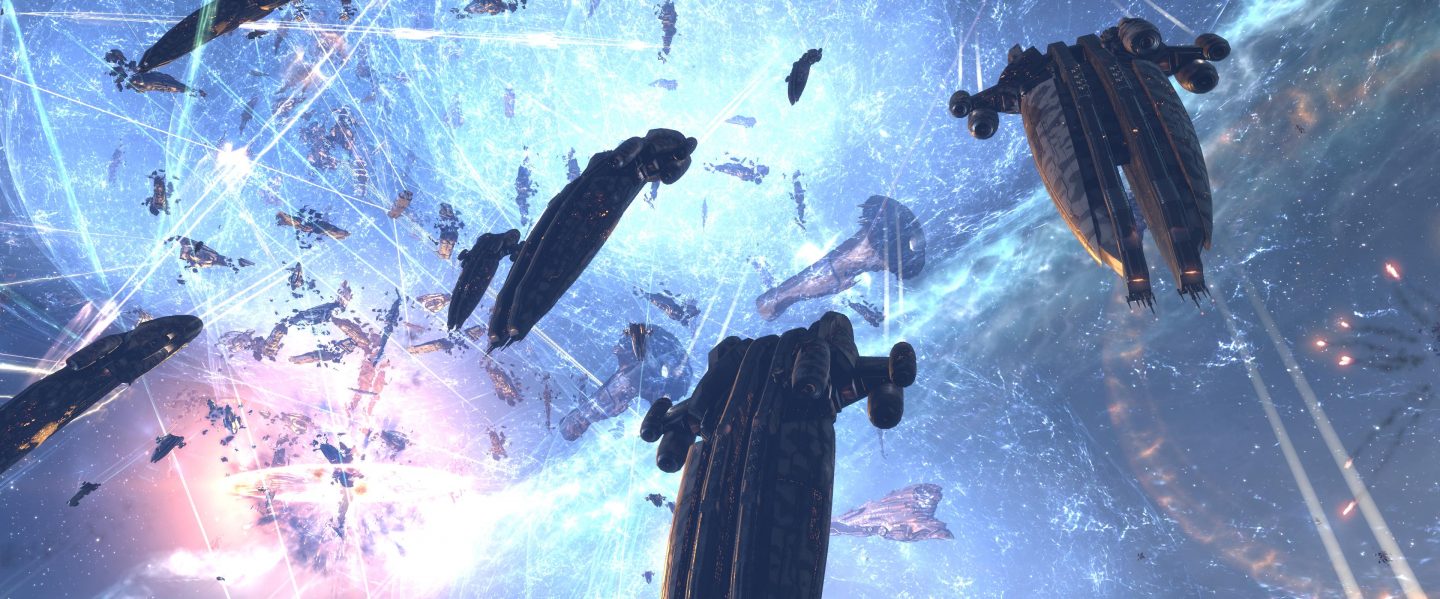
D-GTMI system, Providence region. On the 11th of July at 22:00 EVE Standard Time, forces belonging to Phoebe Freeport Republic [PFR] and Providence Bloc clashed in the system over a Sovereignty Blockade Unit.

The
fight began as an event for [PFR]’s academy, which was celebrating a
graduation cycle and wished to fight Providence Bloc, choosing an
Amarrian motif for its fleet. 57 pilots assembled in an array of Amrrian
ships, with 3 Triage Archon Carriers and a Fenrir Freighter filled with
spirits. The fleet made its way from the 4-CM8I system in Scalding Pass to the D-GTMI system in Providence without an incident.

The Original Post for the Event


The
Fleet Commander for [PFR] attempted to arrange a fight with Providence
Bloc, but was ignored and subsequently banned from the diplomacy channel
of Providence Bloc by moderators. Attempts by other fleets members
resulted in the same pattern. This caused the [PFR] fleet to attempt and
draw Providence Bloc’s attention in another way. Since D-GTMI had
defensive Sovereignty Blockade Units already present in the system, the
[PFR] fleet decided to shoot the station, hoping to alert Providence
Bloc and cause it to form.

After a while though, with no apparent
response, the [PFR] fleet moved to the Sovereignty Blockade Units on the
T-RPFU gate and started applying damage to it, hoping to at least have a
killmail out of it. However, by this time Providence Bloc had already
formed, a 60 pilot mixed Cerberus Heavy Assault Cruiser and Caracal
Cruiser fleet. The force quickly made its why towards the system,
swelling its ranks as it burned forwards.

Deciding not to jump
head long into the [PFR] force, the Providence Bloc fleet took a detour,
attempting to enter the system through FSW-3C.
And yet, the [PFR] force may have had a spy on the Providence Bloc
force, as their fleet relocated to the FSW-3C gate. Luckily, the [PFR]
force was quite a way from the gate, allowing the Providence Bloc fleet
to enter safely and start the fight.

The two sides fought for a
while, the [PFR] fleet completely outgunned and out ranged by the
kitting Cruisers, who ripped apart the Amarrian ships with their missile
salvos. Even with the prevalence of Triage Carriers on the field, the
damage proved too great. Another factor that went against the [PFR]
fleet was the Providence Bloc Stealth Bomber wing, which accompanied the
main fleet and carried bombing runs on the [PFR] fleet.

The Fighting over the FSW-3C Gate


With most
of their sub-capital support gone, the Providence Bloc fleet went to
work on the [PFR] Carriers, taking down the cynosural field mobile
inhibitor and bringing their own Capitals into the system. One after the
other, the [PFR] Carriers were destroyed, the entire [PFR] fleet
decimated.

With no more hostiles left to fight, the Providence
Bloc fleet returned to its staging system, having secured the system
once more.

Battle report for the D-GTMI system can be found here.

The
Battle lasted 40 minutes, with local seeing around 200 pilots at the
height of the battle and Time Dilation not reported as a major issue.

[PFR]
lost nearly the entirety of its fleet, 58 ships including 3 Triage
Carriers and a Freighter, for a total of 12.63Bil ISK damage. Providence
Bloc losses were only 12 ships, mostly Stealth Bombers and Interdictors
totaling at 600Mil ISK damage.

It seems both sides managed to
achieve their objectives, with Providence Bloc defending its sovereignty
while [PFR] getting the fight it wanted, though not in the format it
wished for.

With FozzieSov around the corner and the so-called
impending invasion of the Imperium to the region, this may have been the
last “fun” big fight in the region for the near future.

News Bulletin: corebloodbrothers, State of the Region, Looming Imperium Invasion

Since the departure of Northern Coalition(dot) [NC] from the area, things have calmed down in the Providence region. Thus, not much has transpired during the passing week, giving Providence pilots a much needed breather after nearly two months of constant fighting. The things that did happen, were either unimportant enough to merit their own post or were already covered by other major news outlets. 

The EVE Scribe has gathered all of the events into one news bulletin to keep the pilots of Providence up to date with the occurrences in the region.

corebloodbrothers Resigns his Seat on CSM X


In a move that surprised all, corebloodbrothers announced his resignation from the Council of Stellar Management 10, also known as CSM X. corebloodbrothers cited demands on his time and an inability to balance them with his work on the CSM X as the main reason for choosing to quit the council.


With his resignation, Providence Bloc loses its voice on the council, with the candidate most likely to succeed his seat being a representative of High Security space interests,Lorelei Ierendi. The full resignation letter can be found on EVE News 24.

State of the Providence Region


On the 2nd of July, the G-5EN2 system, the first system conquered by [NC] during its campaign, was finally re-claimed by Providence Bloc forces. This marked the official end of the war between the two entities, with all systems in the region once more safely in Providence Bloc’s control.


With [NC]’s departure, large scale conflicts have subsided in the region, allowing its residents to re-build and resume their peaceful activities. With Pandemic Horde [REKTD] and Spectre Fleet otherwise engaged, it seems Providence Bloc will enjoy the peace for a few more weeks at least.

Pending Imperium Invasion


Only recovering from one war, and already reports are coming in of the Imperium’s preparations to invade the region. The residents of Providence had been reporting increased Imperium activity as well as spikes in border systems, such as Esa in the Tash-Murkon region. 

The system’s close proximity to the Providence region and the Amarr system in Domain which serves as an important trade hub for the South of New Eden, makes it an ideal staging area for sub-capital operations. The station in the system has historically served as the home base for several anti-Providence groups.


As the sovereignty mechanic changes, termed FozzieSov, will probably be implemented next week, bar no further delay, Providence Bloc may face a full scale invasion of its space, as Imperium forces hope to study and perfect the new system in order to protect their holdings in the future, using the region as their testing ground.


This may mean that the coming weeks may make the past two months look like a picnic in comparison. Only time will tell. 

The EVE Scribe will keep you posted.

Lorelei Ierendi
Lorelei Ierendi
Lorelei Ierendi

News: Northern Coalition(dot) Re-Deploys, Drops Sovereignty in Providence

Providence region. Northern Coalition(dot) [NC] announced its new deployment, moving away from the Providence region and to the system of Litom in the Curse region. While [NC] assets haven’t moved yet, sovereignty dropped in several systems, allowing Providence Bloc to grab them.


On the 29th Providence Bloc managed to re-gain BK4-YC system. The system was left undefended by [NC] forces, allowing Providence Bloc to capture it without a fight.


On the 30th, [NC] ceded sovereignty over KBP7-G and Y-MPWL systems, which Providence Bloc was quick to re-claim.


The only system in Providence currently remaining in [NC]’s hands is the G-5EN2 system, which was the first to fall in the campaign. Its eventual re-capture will symbolize the end of the war between [NC] and Providence Bloc.


Providence Bloc forces have kept an eye on the situation, but no major action has been taken against [NC] assets in the region so far. It seems Providence Bloc leadership is awaiting the [NC] convoys to leave Hasateem, thus ensuring [NC] has actually re-deployed.


The news of the deployment came as no big shock, with the entire conflict growing stale as time went on. The question is what does [NC] expect to achieve with its move to the Curse region, which operates as an important junction from which both the East, South East and North East of New Eden can be accessed.


While no comment was given by [NC], Providence Bloc leadership had stated that [NC] proved to be a strong and tough opponent, whose tight fleet compositions, professionalism, commitment and experience proved to be an immense challenge. Providence Bloc had fought hard, and lost a lot, but also manged to win against the odds at times. In summary, it was a war where both sides showed respect for each other, and afterwards come new challenges and new enemies.